Somali Gangs and Rampant Crime
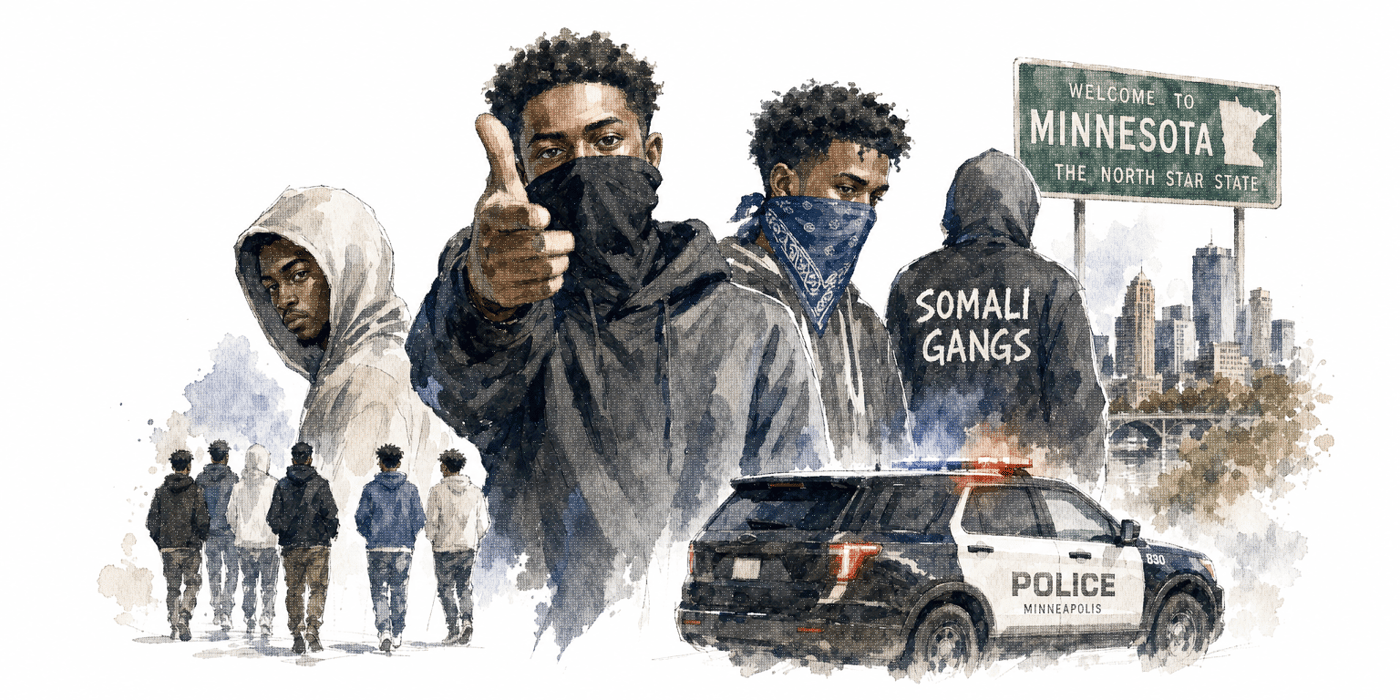
Minnesota boasts the largest Somali population in the U.S., and with that, fraud and gang violence have exploded.
Emmy Griffin Contributor patriotpost.us 10-8-26
Minneapolis-area Somalis are in the news again. Why? Well, it started because a Somali gang shootout disrupted a homecoming football game in a supposedly safer neighborhood outside of Minneapolis. In Eden Prairie, a fight broke out in the stadium during the fourth quarter. Reports say that 150-plus members of a Somali gang began fighting on the stadium grounds, and shooting broke out in the parking lot. The perpetrators were not students of either school. Stadium staff quickly evacuated the stands and players to keep them out of harm’s way, but the story still made national headlines.
Eden Prairie is nowhere near the truly bad part of Minneapolis. It is in a rich, mostly white enclave, and crime is low. It’s not where Somali gang shootings are accepted as part of the background noise. The Somali gang problem has metastasized so much that it’s bleeding (both figuratively and literally) into the wealthier suburbs.
Naturally, leftists continue to tell us that Minnesota does not have a Somali gang problem. They would even point to a statistic put forth by the Cato Institute’s Alex Nowrasteh that says Minnesota Somali immigrant males aged 18–54 are slightly less likely to be incarcerated (1,170 per 100,000) than native-born Americans are (1,221 per 100,000). Matthew Lilley, John Mitchell Fellow at the Australian National University, and Robert VerBruggen, senior fellow at the Manhattan Institute, point out how useless that statistic is in a City Journal article.
For one thing, recent Somali arrivals have had significantly less time to be incarcerated. If you change the qualifications to a longer time span (going back to 2006) and alter the age range to 18-29, with the further qualification that the Somali immigrant had to reside in the U.S. since they were at least 15, then the incarceration rate reflects a more accurate depiction of just how much the Somali population does not follow the law. The incarceration rate jumps from 1,170 per 100,000 for Somalis to 5,030 per 100,000. Native-born American numbers rise to only 2,450 per 100,000.
People who come to a different country with a different culture often assimilate very slowly, if at all. Instead, first-generation immigrants often continue their old culture in their new home. Unfortunately, Somalia ranks 179 out of 180 on Transparency International’s Corruption Perceptions Index, meaning even organizations like the World Bank and the World Economic Forum recognize Somalia as having a corrupt culture.
Minnesota is a deep-blue state. Ten years ago, Democrat Senator Amy Klobuchar, who is now campaigning for governor, told a crowd of Somali immigrants, “We are home to the largest Somali population in the United States, and we are so proud of that fact in Minnesota!” That is still true a decade later.
The Land of 10,000 Lakes has been on the receiving end of tens of thousands of Somali immigrants, and Democrats are massive supporters of multiculturalism. They cling to the moniker “great melting pot” as an antidote to racism; according to their worldview, they can’t be racist if they import a bunch of immigrants from other cultures.
Unfortunately for them, reality shows us that some cultures actually are better than others. When even the WEF calls Somalia corrupt, that says a lot about that culture. If you don’t take that corruption into account, you end up with Somalis defrauding the American taxpayer or Somali gang members starting a fight at a homecoming game that ends in a shooting.
The icing on the hypocrisy cake is that local Minnesota officials are upset that people are noticing Somali gangs shooting up the place on a regular basis. Pointing it out is apparently tantamount to being racist toward the Somali gangs. For the Left, being accused of “racism” is the worst crime imaginable, but at the end of the day, the real issue is cultural, not racial.
When you import people from a failing country ruled by Islamists and warring tribes for centuries (with brief civilization given to them from 1800 to the 1960s), you’re inheriting the chaotic and broken culture that is incompatible with American culture. As our Thomas Gallatin put it:
In brief,
American culture rests on a foundation built on a Judeo-Christian ethic, which
recognizes and prizes the fundamental perspective that all men are created
equal. They all reflect the image of God and, therefore, are inherently endowed
with certain inalienable rights, including life, liberty, and the pursuit of
happiness.
This forms the bedrock of American culture. And it has often been observed that
what the Founders meant by Liberty was not absolute autonomy of the individual
to do whatever they pleased, but rather the freedom of the individual to pursue
happiness, restrained and directed by a shared Judeo-Christian morality.
This morality is only possible when defined by a commonly held set of social
values, which is the essence of culture. Therefore, culture is best identified
not by skin color or ethnic background but by a shared set of values and
practices, which includes views on ethical behavior.
This is why multiculturalism, like socialism, is impossible.
And it’s why Somali gangs will continue to make the news.